

Inside the Race for the World’s Tallest Buildings
Why the world’s tallest buildings matter
The world’s tallest buildings are more than architectural showpieces: they signal economic ambition, concentrate urban land use and push engineering and sustainability boundaries. As cities grapple with population pressure and climate targets, the construction of supertall towers remains a visible indicator of investment, technological progress and questions about long‑term viability.
Main developments and current facts
Who tops the list
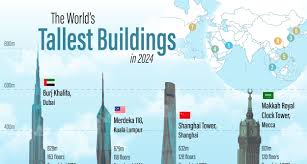
At present, Dubai’s Burj Khalifa remains the tallest completed building in the world at 828 metres. Asia now dominates the upper ranks: Kuala Lumpur’s Merdeka 118 rises to about 678.9 metres and Shanghai Tower reaches 632 metres. Other notable skyscrapers include the Abraj Al‑Bait Clock Tower in Mecca (approximately 601 metres), Shenzhen’s Ping An Finance Centre (about 599 metres) and Seoul’s Lotte World Tower (roughly 554.5 metres).
Definitions and trends
The Council on Tall Buildings and Urban Habitat (CTBUH) classifies skyscrapers of 300 metres or more as ‘supertall’ and those of 600 metres or more as ‘megatall’. The last decade has seen a steady increase in both categories, driven mainly by projects in Asia and the Middle East. Developers favour mixed‑use programmes—combining offices, residences and hotels—to make very tall projects economically viable.
Projects and constraints
Several high‑profile proposals, such as the planned Jeddah Tower which aimed to exceed 1,000 metres, remain incomplete or paused, illustrating financial and logistical limits. Advances in materials, wind engineering and lift systems enable greater heights, but costs, planning rules, and sustainability expectations increasingly shape which projects proceed.
Conclusion: what readers should take away
Record‑breaking towers will continue to attract attention, but the future of the world’s tallest buildings is likely to balance ambition with practicality. Expect more supertalls in dense Asian and Middle Eastern cities, incremental technical innovations, and stronger scrutiny of environmental and social impacts. For readers, these trends matter because they influence city skylines, real‑estate markets and debates about sustainable urban growth.