

Exploring the South Atlantic Anomaly: Causes and Implications
Introduction
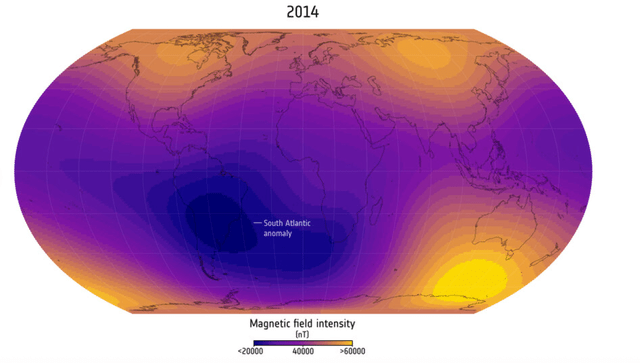
The South Atlantic Anomaly (SAA) is an area of weakened magnetic field located over the South Atlantic region, primarily affecting Brazil and extending into southern Africa. This phenomenon has garnered significant attention among geophysicists and space scientists due to its implications for satellites and space missions. Understanding the SAA is crucial for safeguarding technology and ensuring the continued success of space exploration.
What is the South Atlantic Anomaly?
The SAA is a region where the Earth’s magnetic field is significantly weaker than the global average. It is caused by the tilt of Earth’s magnetic dipole axis and an offset in its location from the rotational axis. This weak magnetic field allows higher levels of cosmic radiation to penetrate, posing risks to satellites that orbit the area.
Recent Observations and Developments
Recent studies have indicated that the SAA has been growing in size and intensity over the past few decades. Researchers from the European Space Agency (ESA) reported in 2023 that the SAA has expanded considerably, affecting an area that now covers much of South America and parts of the southern Atlantic Ocean. This expansion has raised concerns about the potential impact on space missions, particularly for satellites passing through the anomaly’s path, which face increased radiation exposure and potential malfunctions.
Impact on Satellites and Technology
Satellites operating within the SAA are at a higher risk of experiencing data loss, sensor errors, and shorter operational lifespans. For instance, NASA’s Van Allen Probes have mapped the intensity of radiation within the anomaly, providing valuable data for assessing risks. Operators of satellites have begun adjusting their orbits or altering operational modes when traversing the SAA to mitigate risks.
Scientific Significance
The South Atlantic Anomaly is not only crucial for satellite operations but also offers insight into the Earth’s magnetic field dynamics. Researchers believe that studying the SAA can provide clues about the behavior of the Earth’s core and its magnetic field’s future trajectory. Due to its unique properties, the SAA stands as a natural laboratory for understanding geomagnetism, contributing to broader studies of planetary sciences.
Conclusion
<pAs the South Atlantic Anomaly continues to evolve, its significance grows for satellite operators and scientists alike. Understanding this anomaly is essential for ensuring the safety of satellite missions and fostering advancements in our knowledge of Earth's magnetic field. As research progresses, there will likely be more insights into how this phenomenon may further develop, influencing future technologies and scientific theories.