

25th Amendment Returns to Headlines Amid Fresh Calls for Presidential Removal
Understanding the 25th Amendment
The Twenty-Fifth Amendment to the Constitution was ratified on February 10, 1967, establishing and explaining the complete order of presidential succession, as well as a series of contingency plans to fill any executive vacancies. It was ultimately the assassination of President John F. Kennedy in 1963 which finally pushed Congress to create a detailed, specific, and unambiguous outline of executive succession. The amendment addresses what happens when a president dies, resigns, becomes incapacitated, or is otherwise unable to fulfill their duties.
Recent Calls to Invoke Section 4
A Bay Area Democratic congressman has added their voice to a growing chorus of people calling for the 25th Amendment to be invoked over a letter President Donald Trump sent Norway’s Prime Minister, in which Trump appears to connect his interest in the United States taking over Greenland to being bypassed for the Nobel Peace Prize. The letter revived calls similar to those heard during the first Trump administration for using the 25th Amendment to remove him from office. U.S. Sen. Ed Markey (D-MA) tweeted ‘Invoke the 25th Amendment,’ whilst East Bay Democratic Rep. Eric Swalwell (D-Livermore) simply tweeted ’25,’ along with a copy of the letter.
How Section 4 Works
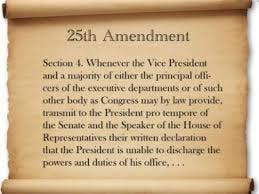
Section 4 allows the vice president, together with a majority of either the principal officers of the executive departments or of such other body as Congress may by law provide, to issue a written declaration that the president is unable to discharge his duties; when such a declaration is sent to Congress, the vice president immediately becomes acting president. Section 4 of the 25th Amendment—perhaps the most complex part of the amendment, which has never been invoked—allows for the vice president and a majority of cabinet secretaries to declare the president unable to discharge the powers and duties of the office.
Political Reality and Significance
No member of Trump’s cabinet has signalled any intention of removing President Trump from office. While the constitutional mechanism exists, its invocation remains politically unlikely given the requirement for cooperation between the vice president and a majority of Cabinet members. The 25th Amendment pertains to what happens if the president or vice president becomes incapacitated — either mentally or physically — and is unable to fulfil their duties; under the amendment, members of the president’s cabinet could legally remove him from office if they do not believe he is fit to lead. The current debate underscores ongoing questions about presidential fitness and the constitutional tools available to address such concerns, even as their practical application remains extraordinarily rare in American political history.